Basic Policy on Corporate Governance
This Basic Policy sets forth the guiding principles of the Company’s corporate governance, with the aim of contributing to the sustainable growth of the Company and its group companies (hereinafter referred to as the “Shibuya Group”) and the enhancement of its corporate value over the medium to long term.
Corporate Governance Report (PDF: 167KB)
Chapter 1: General Provisions
Article 1: Fundamental Principles of Corporate Governance
- The Company believes that enhancing corporate governance is essential for ensuring transparent, fair, prompt, and decisive decision-making, while taking into account the interests of customers, shareholders, business partners, employees, local communities, and other stakeholders. Accordingly, the Company is committed to enhancing its corporate governance in accordance with the following fundamental principles.
- The Company respects the rights of shareholders and endeavors to ensure the equal treatment of shareholders.
- The Company recognizes the importance of its social responsibilities, takes into consideration the interests of various stakeholders—including customers, shareholders, business partners, employees, and local communities—and engages in appropriate collaboration with them.
- The Company endeavors to ensure appropriate disclosure of corporate information, including non-financial information, and to secure transparency in management.
- The Company endeavors to ensure the effectiveness of the supervisory function over business execution through its Board of Directors, which includes Independent Directors.
- The Company engages in constructive dialogue with stakeholders in order to contribute to sustainable growth and the enhancement of corporate value over the medium to long term.
- The Company has Code of Conduct as a set of fundamental principles to be shared by all officers and employees of the Shibuya Group and to serve as the basis for all activities.
- The Company has separately disclosed its views on the sources of corporate value necessary for achieving sustainable growth and enhancing corporate value over the medium to long term.
Chapter 2: Ensuring Shareholders’ Rights and Equality
Article 2: Ensuring Equality Among Shareholders
- The Company treats all shareholders equally according to their shareholdings and endeavors to disclose information in a timely and appropriate manner so as to prevent information disparities among shareholders.
Article 3: Policy on Cross-Shareholdings
- The Company may hold shares in business partners or alliance partners with whom it maintains cooperative relationships, where maintaining or strengthening stable business relationships with such partners is deemed to contribute to the corporate value of the Shibuya Group.
- With respect to major shareholdings held pursuant to the preceding paragraph, the Company verifies their medium- to long-term economic rationality and the effectiveness of such holdings from the perspective of maintaining and strengthening stable relationships with business partners and reports the results to the Board of Directors.
- While the Company holds shares in accordance with the policy set forth in paragraph 1, it determines the exercise of voting rights for each holding based on a comprehensive assessment of the overall management condition of the relevant company, including its business performance.
Chapter 3: Appropriate Collaboration with Stakeholders Other Than Shareholders
Article 4: Management System for Related Party Transactions
When the Shibuya Group engages in transactions with its officers, major shareholders, or other related parties, such transactions shall, in principle, be submitted to the Board of Directors in advance for approval, unless it is clear that the terms and conditions of such transactions are equivalent to those of ordinary transactions, in order to ensure that such transactions do not harm the interests of the Shibuya Group or the common interests of shareholders.
Article 5: Management System for Conflict-of-Interest Transactions
If a Director of the Shibuya Group becomes aware of any conflict-of-interest issue concerning the Director, including potential conflicts, they shall promptly report the matter to the Board of Directors and obtain its approval.
Article 6: Compliance Whistleblowing System
The Shibuya Group has established a whistleblowing system that allows all officers and employees to report directly to external attorneys or Audit and Supervisory Board Members, separately from normal reporting lines, in order to respond promptly and appropriately to violations of laws and regulations.
Chapter 4: Appropriate Information Disclosure and Ensuring Transparency
Article 7: Policy on the Corporate Governance Structure
From the perspective of achieving sustainable growth and enhancing corporate value over the long term, the Company strives to achieve effective and efficient management and, in accordance with the Companies Act and other applicable laws and regulations, determines and discloses its policies concerning risk management, internal control systems, and legal compliance of the Shibuya Group in a timely and appropriate manner.
Chapter 5: Responsibilities of the Board of Directors
Section 1: Responsibilities of the Board of Directors as a Supervisory Body
Article 8: Roles of the Board of Directors
- The Board of Directors is responsible for supervising business execution and overall management, ensuring fairness and transparency in management, and making decisions on important matters related to business execution that are required by law to be resolved by the Board of Directors.
- Authority to execute and make decisions on operations other than the important matters referred to in the preceding paragraph is delegated to the President and CEO, Executive Directors, and other relevant officers, while the Board of Directors supervises the execution of their duties.
- The Company’s Independent Directors evaluate the Company’s business performance and the activities of Directors in charge of business execution in light of the management strategies and plans approved by the Board of Directors, provide advice on management policies and improvements from the perspective of the common interests of all shareholders, and oversee conflicts of interest between the Company and controlling shareholders.
- Recognizing the importance of environmental and social issues related to sustainability, the Board of Directors establishes a basic policy on the Shibuya Group’s social responsibility (Compliance Guidelines), raises awareness among officers and employees, and seeks to achieve the sustainable development of society and enhance the Shibuya Group’s corporate value while taking into account the interests of stakeholders.
Section 2: Effectiveness of the Board of Directors
Article 9: Composition of the Board of Directors
- The Company’s Board of Directors consists of up to seven members as stipulated in the Articles of Incorporation, and Directors are appointed to ensure an appropriate balance of knowledge, experience, and abilities.
- The Company’s outside officers meet the independence criteria set forth in the Companies Act and by the relevant financial instruments exchanges. (The Company’s criteria for determining the independence of outside officers are available in PDF format at the end of this document.)
Article 10: Qualifications and Nomination Procedures for Directors
- Candidates for Directors are selected from a broad and diverse pool of talent in accordance with the following nomination policy:
- Candidates must have insight, ability, and extensive experience in the business operations and management of the Group as a whole.
- Candidates must have a sufficient understanding of the social responsibilities and mission of corporate management and the fiduciary duty to shareholders and be capable of executing business operations and management fairly and appropriately based on high ethical standards.
- Notwithstanding the preceding paragraph, candidates for Independent Directors are selected from a broad and diverse pool of talent in accordance with the following nomination policy:
- Candidates must be deemed to have no risk of conflicts of interest with general shareholders.
- Candidates must understand the Company’s corporate philosophy and have a sufficient understanding of the responsibilities and roles of corporations as members of society.
- Candidates must be fully aware of their role as Independent Directors and be capable of overseeing the Company’s Directors and management and providing appropriate opinions and advice by leveraging their knowledge and experience in fields such as corporate management, economics, law, accounting, and taxation.
Article 11: Qualifications and Nomination Procedures for Audit and Supervisory Board Members
- Candidates for Audit and Supervisory Board Members are selected from a broad and diverse pool of talent with the consent of the Audit and Supervisory Board in accordance with the following nomination policy:
- Candidates must have insight, ability, and extensive experience in the business operations and management of the Group as a whole.
- Candidates must be capable of auditing the execution of duties by Directors from a fair and objective standpoint and contributing to the enhancement of management soundness and transparency.
- Notwithstanding the preceding paragraph, candidates for Independent Audit and Supervisory Board Members are selected from a broad and diverse pool of talent with the consent of the Audit and Supervisory Board in accordance with the following nomination policy:
- Candidates must be deemed to have no risk of conflicts of interest with general shareholders.
- Candidates must understand the Company’s corporate philosophy and have a sufficient understanding of the responsibilities and roles of corporations as social entities.
- Candidates must be fully aware of their role as Independent Audit and Supervisory Board Members and be capable of auditing the execution of duties by Directors from a neutral and objective perspective and contributing to the enhancement of management soundness and transparency by leveraging their knowledge and experience in fields such as corporate management, economics, law, accounting, taxation, and auditing.
Article 12: Policy on Training for Directors and Audit and Supervisory Board Members
- The Company supports Directors and Audit and Supervisory Board Members in the execution of their duties by collecting and providing information necessary for fulfilling their roles and functions, including information on economic conditions, industry trends, legal compliance, corporate governance, business and organization, and financial accounting.
- When taking office, the Company’s Independent Directors and Independent Audit and Supervisory Board Members receive briefings on the Company’s corporate culture, management policies, industry conditions, and its business, financial, and organizational matters in order to develop sufficient understanding necessary to fulfill their roles and functions.
Chapter 6: Dialogue with Shareholders
Article 13: Policy on Constructive Dialogue with Shareholders
The Company endeavors to engage in constructive dialogue with shareholders and investors while fairly providing accurate information, in order to achieve sustainable growth and enhance corporate value over the medium to long term. In addition, when it is deemed beneficial for achieving the above objectives, the Company endeavors to engage in individual dialogue with shareholders and investors, while paying due attention to the fairness of information disclosure and the prevention of insider information leakage, and to sincerely consider their views.
(Effective Date)
This Basic Policy shall come into effect on February 12, 2016.
(Last Revised: September 30, 2024)
Sources of Corporate Value (PDF: 244KB)
Independence Criteria for Outside Officers (PDF: 90KB)
Corporate Governance Structure
As of April 6, 2026
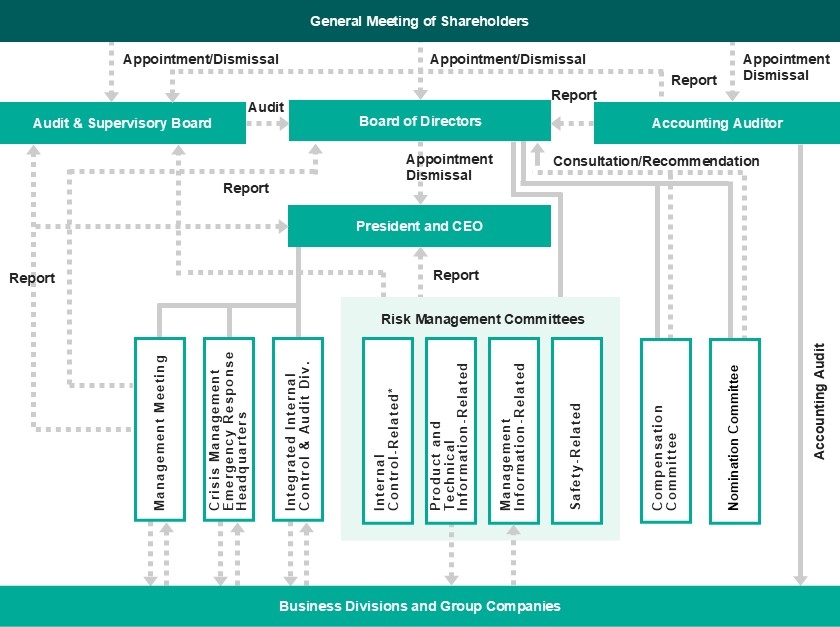
Note: A Sustainability Committee has been established under the Internal Control-Related Committees.